

Yes, a kitchen island can be beautiful without becoming the room’s dominant feature. The best supporting islands use balanced proportions, practical materials, restrained pattern, and details that connect with the cabinets, flooring, lighting, and surrounding architecture.
We explain this to homeowners visiting granite stores in Kingston Springs, TN because an island does not need dramatic veining, contrasting cabinets, or oversized pendants to feel intentional. At ARCountertops, we often design islands that improve workflow and seating while allowing a range wall, window view, custom hood, or dining area to remain the main visual focus.
What Does a Supporting Island Do?
A supporting island improves function and balance without demanding attention from every direction.
It may provide preparation space, storage, seating, a sink, or room for serving. Its design repeats materials already present in the kitchen instead of introducing several new colors or patterns.
| Island role | Useful design response | Visual result |
|---|---|---|
| Food preparation | Durable surface and clear work zone | Practical and calm |
| Family seating | Comfortable overhang and softened edges | Inviting, not oversized |
| Storage | Cabinetry matching the perimeter | Continuous appearance |
| Serving | Open surface with few interruptions | Simple and flexible |
| Sink location | Quiet pattern around the cutout | Less fragmentation |
A supporting island still needs good proportions. If it is too large, too dark, or surrounded by oversized fixtures, it becomes the focal point whether that was intended or not.
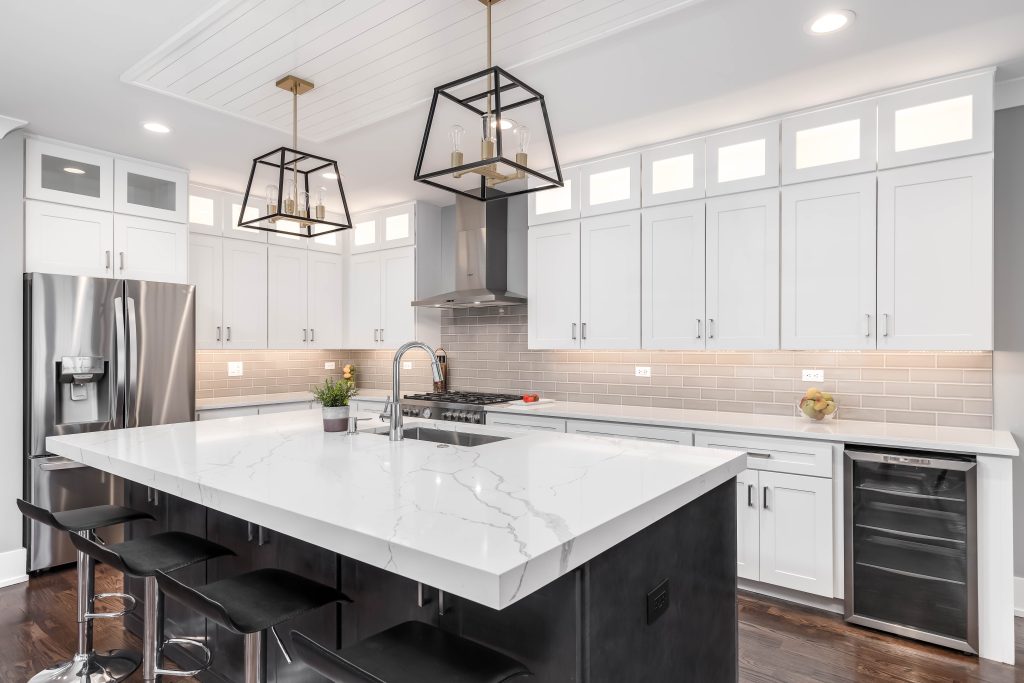
Does the Island Have to Contrast With the Perimeter?
No, matching or coordinating the island with the perimeter often creates a more spacious and cohesive kitchen.
A different cabinet color can work, but contrast is not required. Repeating the same paint or wood finish allows the island to feel like part of the architecture rather than a separate piece of furniture.
The countertop can match exactly or stay within the same color family. A warm gray granite perimeter and a quieter warm gray island can add depth without creating a hard visual break.
When homeowners compare granite stores in Kingston Springs, TN, we encourage them to review the entire palette together. An island selected separately from the cabinets, floor, and backsplash often becomes louder than expected.
Which Stone Patterns Keep an Island Visually Quiet?
Fine mineral patterns, soft clouding, low-contrast movement, and near-solid colors keep an island visually quiet.
Granite with evenly distributed minerals works well because it offers natural depth without one dominant vein controlling the room. Quartz provides the most predictable color, while lightly veined marble and quartzite can also remain restrained.
| Pattern type | Visual strength | Best use |
|---|---|---|
| Fine salt-and-pepper granite | Low | Busy family kitchens |
| Soft cloudy quartz | Low | Modern or transitional spaces |
| Low-contrast linear movement | Moderate | Long rectangular islands |
| Wide dark veining | High | Islands intended to lead |
| Large multicolor crystals | High | Very simple surroundings |
At ARCountertops, we look at the slab from ten to fifteen feet away. Fine details that feel active up close often blend into a calm field when viewed from the living or dining room.
Can a Quiet Island Still Look Custom?
Yes, precise fabrication and proportion can make a restrained island look more custom than a heavily patterned slab.
Clean seams, consistent overhangs, aligned edges, and a centered sink are easy to notice on a simple surface. A modest eased edge can look refined when the island dimensions and cabinet reveals are accurate.
Customization can also come from practical details. Integrated outlets, concealed supports, a carefully sized seating overhang, and a well-planned sink position improve the island without turning it into a statement piece.
How Should the Island Relate to the Main Focal Point?
The island should support the focal point through color, direction, and sightlines rather than compete with it.
If the range wall has a custom hood and full-height backsplash, the island can repeat one background tone from that wall. If large windows frame a wooded view, a low-contrast surface keeps the eye moving toward the outdoors.
| Main focal point | Island strategy |
|---|---|
| Custom range hood | Use quiet stone and simple pendants |
| Full-height slab backsplash | Repeat the slab’s background color |
| Large windows or view | Choose low-contrast materials |
| Statement lighting | Keep countertop movement restrained |
| Detailed cabinetry | Match the island to the perimeter |
For projects involving granite stores in Kingston Springs, TN, we review the first view from the kitchen entrance. That perspective often determines whether the island supports or blocks the intended focal point.
Should Pendant Lights Be Subtle Too?
Yes, pendant lights should usually be restrained when the island is meant to play a supporting role.
Large sculptural fixtures automatically pull attention downward. Smaller shaded pendants, simple glass forms, or recessed lighting can provide task illumination without creating a second major statement.
Does a Waterfall Edge Make the Island a Focal Point?
Usually, a waterfall edge increases visual importance because it extends the countertop pattern vertically.
A waterfall can remain quiet when the material has little contrast and the joint is precisely aligned. Bold quartzite or heavily veined quartz wrapping down both ends will almost always make the island the main feature.
We recommend waterfalls when they solve a design or durability goal, such as protecting an exposed cabinet end, not simply because they are available.
Which Materials Work Best for a Supporting Island?
Granite and quartz are usually the easiest materials for a supporting island because they offer many quiet patterns and practical performance.
Granite handles heat well and provides natural variation. Quartz requires no sealing and resists most household stains, but it should be protected from hot cookware and heat-producing appliances.
| Material | Visual control | Heat resistance | Stain resistance | Maintenance |
|---|---|---|---|---|
| Granite | Moderate | Excellent | Very good when sealed | Sealer testing |
| Quartz | Excellent | Moderate | Excellent | No sealing |
| Marble | Moderate | Good | Moderate when sealed | Etch awareness |
| Quartzite | Moderate | Excellent | Very good when sealed | Sealer testing |
Marble works when the household accepts etching and patina. Quartzite offers strong heat resistance and natural movement, but dramatic slabs can make the island more dominant than planned.
What Edge Profile Keeps the Design Calm?
A simple eased, pencil, or small-radius edge keeps the island refined without adding visual weight.
Decorative ogee or stacked edges can make a restrained surface feel more formal and prominent. Thick mitered edges also increase the island’s architectural presence.
For homes with children or narrow walkways, softened corners are practical and visually simple.
How Much Overhang Does Island Seating Need?
Most island seating needs approximately 12–15 inches of clear knee space, depending on counter height and cabinet structure.
A standard 36-inch-high counter usually feels comfortable with about 12–15 inches of overhang. Deeper overhangs may require steel brackets, concealed supports, or structural framing.
The seating layout should also allow roughly 24 inches of width per person.
How Much Do Island Countertops Cost?
Installed island surfaces generally cost about $45 to more than $200 per square foot, depending on the material and fabrication details.
| Material | Typical installed range |
|---|---|
| Granite | $45–$120+ per sq. ft. |
| Quartz | $55–$140+ per sq. ft. |
| Marble | $70–$180+ per sq. ft. |
| Quartzite | $80–$200+ per sq. ft. |
The final cost is affected by slab quantity, island dimensions, sink or cooktop cutouts, edge profile, overhang supports, seams, demolition, delivery, and access. A waterfall edge may require substantially more material and labor than a standard finished end.
At ARCountertops, we prepare estimates after reviewing the cabinet plan and selected slab. Homeowners researching granite stores in Kingston Springs, TN should ask whether templating, fabrication, cutouts, support review, delivery, sealing, and installation are included.
What Is Included in Professional Fabrication and Installation?
Professional service includes measuring, slab planning, cutting, edge finishing, cutouts, seam preparation, delivery, and installation.
A typical island project may include:
- Material and finish consultation
- Digital templating
- Full-slab layout review
- Sink or cooktop cutouts
- Edge and corner fabrication
- Seam planning
- Overhang support review
- Delivery and professional installation
- Sealing when natural stone requires it
- Final care instructions
At ARCountertops, we also confirm seating clearance, appliance specifications, cabinet anchoring, and surrounding walkways before fabrication.
How Long Does the Project Take?
Most island countertop projects take approximately 10–14 business days from final templating to installation.
| Project stage | Typical timing |
|---|---|
| Material selection | 1–5 days |
| Digital templating | One appointment |
| Slab layout review | 1–2 days if needed |
| Fabrication | 5–10 business days |
| Installation | Usually one day |
| Plumbing reconnection | Same day or next day |
Before measuring through granite stores in Kingston Springs, TN, the island cabinets should be installed, level, secured, and permanent. Sink, faucet, cooktop, outlets, and support details should also be final.
What Mistakes Make an Island Too Dominant?
The biggest mistakes are combining too many statement features and oversizing the island for the room.
We recommend avoiding:
- Bold stone with contrasting cabinets and oversized pendants
- Waterfalls added without a clear purpose
- Thick decorative edges on an already large island
- High-contrast veining beside a dramatic range wall
- Too many stools along a short overhang
- A cabinet color unrelated to the rest of the kitchen
- Narrow walkways created by excessive depth
A beautiful island does not need to announce itself. It can improve the room simply by being well proportioned, easy to use, and connected to the surrounding materials.
FAQ
Does an island need a different countertop from the perimeter?
No. Matching countertops often create a more cohesive and spacious appearance.
Which stone pattern keeps an island subtle?
Fine mineral patterns, soft clouding, and low-contrast movement usually remain visually calm.
Will a waterfall edge make the island stand out?
Usually yes. It adds vertical surface area and makes the stone more prominent.
Which material requires the least maintenance?
Quartz requires no sealing and offers strong everyday stain resistance.
Which stone handles hot cookware best?
Granite and quartzite provide excellent heat resistance, although we still recommend trivets.
How much seating overhang is needed?
Approximately 12–15 inches is common for a standard counter-height island.
Can a simple island still look custom?
Yes. Precise proportions, seams, edges, supports, and outlet placement create a custom result.
How long does installation take?
Most projects take about 10–14 business days after final templating.
About ARCountertops
Our showroom is located at 1771 US-70, Kingston Springs, TN 37082. Homeowners can reach our team at (615) 798-0912.
We serve Nashville, TN, Kingston Springs, TN, and surrounding communities with material selection, digital templating, slab layout planning, custom fabrication, sink and cooktop cutouts, edge finishing, support review, delivery, sealing, and professional installation. We work with granite, quartz, marble, and quartzite for islands, perimeter counters, kitchens, bathrooms, vanities, waterfall panels, and other residential surfaces.
Our suppliers include Cambria, MSI, Cosmos Surfaces, Stoneland, Avani Marble and Granite, Daltile, OHM International, Cosentino Nashville, and Wilsonart.
For homeowners visiting granite stores in Kingston Springs, TN, we help coordinate pattern, color, proportions, seating, edges, supports, pricing, fabrication, and installation so the island enhances the kitchen without overpowering it.