
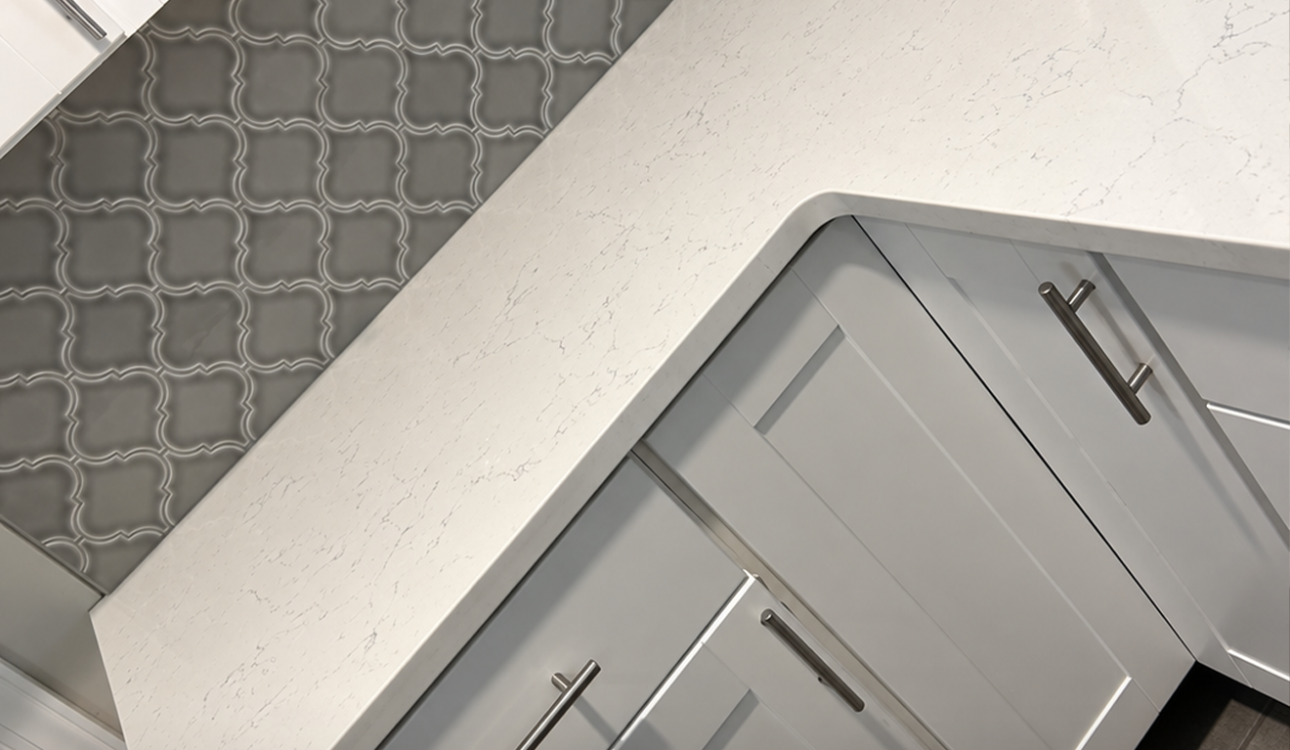
A quartz island can look expensive in a showroom and strangely artificial once it fills the center of a kitchen. The problem is usually not quartz itself; it is a vein pattern that is too repetitive, too sharp, too small for the island, or cut without a layout plan.
For homeowners choosing quartz countertops in Smyrna, TN, the most important visual question is whether the veining still feels believable across six, seven, or eight feet of surface. At ARCountertops, we review the full pattern before fabrication because an island exposes every design decision more clearly than a short perimeter run.
What Quartz Veining Mistake Makes an Island Look Fake?
The biggest mistake is choosing a dramatic vein pattern without checking how it repeats across the full slab.
A small sample may show one beautiful gray or taupe vein. On a large island, the same line may repeat at regular intervals, stop abruptly near a seam, or create a pattern that feels printed rather than naturally varied.
| Veining issue | What it looks like after installation | Better approach |
|---|---|---|
| Repeating identical veins | Printed or stamped | Review the full slab |
| Veins too small for island | Busy, fragmented | Choose larger-scale movement |
| Hard vein edges | Graphic instead of natural | Look for softer transitions |
| Poor seam alignment | Pattern appears broken | Plan seams before cutting |
| Random waterfall direction | Island looks pieced together | Coordinate top and side panels |
The best quartz pattern does not need to copy marble perfectly. It needs to look intentional at the scale of the room.

Why Does Vein Scale Matter So Much on an Island?
Vein scale matters because a large island turns the countertop into a major visual surface.
On a small vanity, tight veining can look detailed and interesting. On a large kitchen island, the same pattern can become noisy because the eye sees many repeated lines at once. Broad, irregular movement usually feels more natural on a larger surface.
When we help clients select quartz countertops in Smyrna, TN, we look at the island dimensions before recommending a pattern. A 3-by-6-foot island and a 4-by-10-foot island need very different visual scale.
Why Do Small Quartz Samples Cause Bad Decisions?
Small samples cause bad decisions because they show color and finish but rarely show full movement.
A 4-inch or 12-inch sample can help homeowners decide whether the background is warm white, cool white, greige, or cream. It cannot show how often a vein repeats across a slab or where the strongest lines will land after fabrication.
At ARCountertops, we encourage clients to look at a larger display or full slab whenever the quartz has visible veining. That is especially important when the island will be the focal point of the kitchen.
Which Veining Looks Most Natural on a Large Island?
Soft, broken, irregular veining with varied thickness usually looks most natural on a large island.
Patterns that fade in and out tend to feel more believable than one dark line repeated across a bright white background. Warm white, greige, taupe, and soft gray backgrounds can also make the veining feel less harsh.
| Vein style | Visual effect | Best use |
|---|---|---|
| Fine repeated lines | Detailed but potentially busy | Small counters |
| Soft broken veins | Natural and calm | Large islands |
| Broad marble-look movement | Dramatic but balanced | Statement islands |
| Cloudy movement | Quiet depth | Open kitchens |
| High-contrast black veins | Strong focal point | Simple rooms |
The goal is not to eliminate movement. It is to make the movement feel proportionate to the surface.
How Can a Seam Make Quartz Look More Artificial?
A seam can make quartz look artificial when it cuts through bold veining without regard to direction or visual continuity.
Large islands may require more than one slab depending on dimensions, slab size, access, and fabrication constraints. If a seam is necessary, it should be reviewed alongside the pattern rather than chosen only for convenience.
A strong vein that stops at one side of the seam and restarts in an unrelated direction on the other side can make the engineered nature of the material much more obvious.
Do Waterfall Edges Make Veining Mistakes More Noticeable?
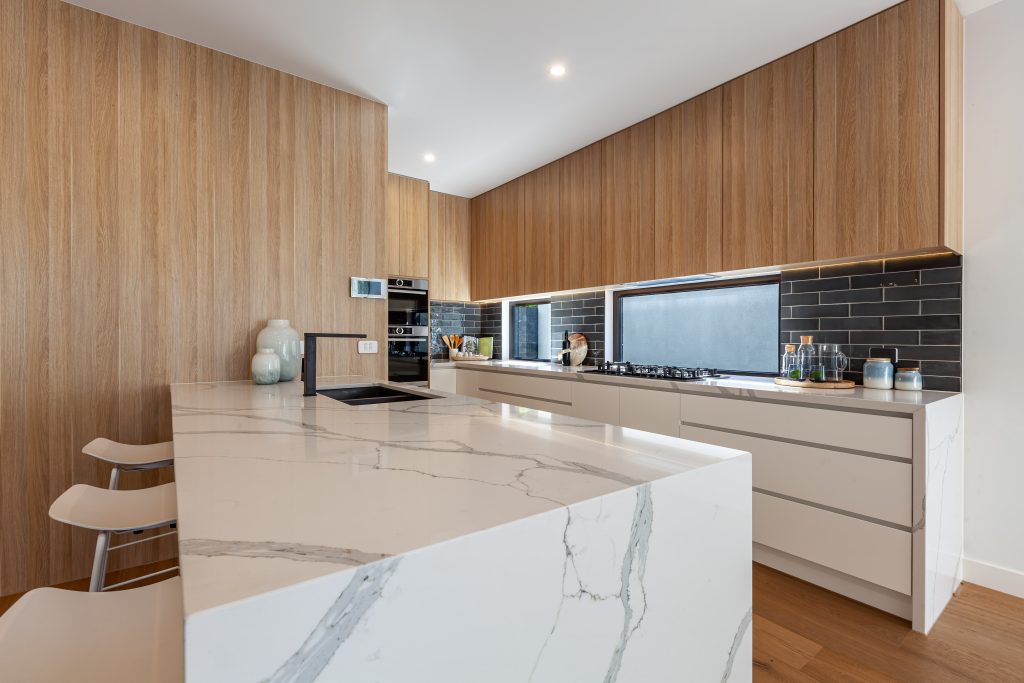
Yes. Waterfall edges make vein direction more noticeable because the pattern moves from a horizontal surface to a vertical panel.
A well-planned waterfall can make an island feel custom. A poorly aligned waterfall can make the top and side look like unrelated pieces.
For quartz countertops in Smyrna, TN, we review whether the design needs vein continuation, coordinated direction, or a quieter side panel before fabrication. The correct answer depends on the specific quartz pattern and slab dimensions.
How Do Quartz, Granite, Marble, and Quartzite Look Different on an Island?
Quartz provides controlled movement, granite provides mineral variation, marble provides soft natural veining, and quartzite often provides large-scale natural movement.
Each material behaves differently in daily use as well as visually.
| Material | Visual character | Heat resistance | Maintenance |
|---|---|---|---|
| Quartz | Controlled pattern | Moderate | No sealing |
| Granite | Mineral-rich natural variation | Excellent | Sealer checks |
| Marble | Soft veining and patina | Good | Higher |
| Quartzite | Large natural movement | Excellent | Sealer checks |
Marble can etch from lemon juice, vinegar, wine, tomato sauce, and some cleaners. Granite and quartzite offer excellent heat resistance, while quartz is non-porous and does not require sealing.
At ARCountertops, we explain both the look and the lifestyle differences so the island is chosen for real daily use, not only for a showroom photo.
How Much Do Quartz Countertops Cost?
Quartz countertops typically cost about $55-$140+ per square foot installed, depending on brand, color, slab size, pattern, edge profile, cutouts, backsplash work, delivery, and installation conditions.
Granite usually ranges from $45-$120+ per square foot installed. Marble often ranges from $70-$180+, and quartzite usually ranges from $80-$200+.
| Material | Typical installed range | Island planning note |
|---|---|---|
| Granite | $45-$120+ per sq. ft. | Natural pattern must be laid out |
| Quartz | $55-$140+ per sq. ft. | Vein repeat and seam plan matter |
| Marble | $70-$180+ per sq. ft. | Vein layout and patina expectations matter |
| Quartzite | $80-$200+ per sq. ft. | Strong movement needs careful placement |
Homeowners pricing quartz countertops in Smyrna, TN should ask whether the estimate includes digital templating, fabrication, sink and cooktop cutouts, faucet-hole drilling, edge finishing, delivery, installation, and any waterfall or backsplash pieces. At ARCountertops, we prepare estimates around the actual layout because a large island can change slab quantity, seam location, waste, and fabrication complexity.
What Fabrication Details Keep Quartz Looking Natural?
Full-slab layout, accurate templating, planned seams, clean cutouts, edge finishing, and waterfall planning keep quartz looking natural.
A complete project may include:
- Material and color consultation
- Digital templating
- Full-slab layout review
- Seam and corner planning
- Sink, cooktop, and faucet cutouts
- Faucet-hole drilling
- Edge fabrication and polishing
- Waterfall or backsplash fabrication
- Delivery and professional installation
- Final care instructions
These details matter more on an island because there is nowhere for a bad transition to hide.
How Long Does a Quartz Countertop Project Take?
Most quartz projects take about 10-14 business days from final templating to installation when material is available.
Material selection may take 1-5 days. Layout review can take 1-2 days for directional or bold-veined quartz. Fabrication usually takes 5-10 business days, and installation is often completed in one day.
| Project stage | Typical timing |
|---|---|
| Material selection | 1-5 days |
| Digital templating | One appointment |
| Layout review | 1-2 days if needed |
| Fabrication | 5-10 business days |
| Installation | Usually one day |
Before templating quartz countertops in Smyrna, TN, cabinets should be installed, level, secured, and permanent. Sink, faucet, cooktop, appliances, overhangs, edge profile, seam preferences, backsplash direction, and waterfall details should also be final.
What Mistakes Make a Quartz Island Look Fake?
A quartz island looks fake when the pattern scale, lighting, seams, and surrounding materials are not considered together.
We recommend avoiding:
- Choosing from a tiny sample only
- Selecting the boldest vein without checking the full slab
- Ignoring repeated pattern sections
- Allowing strong veins to break awkwardly at seams
- Using a waterfall without planning direction
- Pairing high-contrast quartz with a busy backsplash
- Using very cool lighting with stark white quartz
- Reviewing price without checking included fabrication details
For Smyrna, TN kitchens, a quieter pattern often looks more expensive than a dramatic pattern with poor scale.
What Is the Best Quartz Pattern for an Island?
The best quartz pattern for an island has movement large enough for the surface, soft enough to avoid obvious repetition, and flexible enough to work with the seam and edge plan.
Warm white, greige, beige-gray, cloudy patterns, and marble-look quartz with broken veining are often easier to use than highly repetitive high-contrast designs.
A good island should look intentional from across the room and still feel believable when someone stands beside it.
FAQ
Why does some quartz look fake on an island?
It usually looks fake when the veining repeats too clearly, is too small for the island, has hard edges, or is poorly aligned at seams and waterfalls.
What quartz veining looks most natural?
Soft, broken, irregular veining with varied thickness and a layered background generally looks most natural.
Should I see a full slab before choosing quartz?
Yes. Full-slab review is especially useful for veined quartz because a small sample cannot show pattern scale or repetition.
Is marble-look quartz a good choice for islands?
Yes. It can provide marble-style movement with lower maintenance, but vein scale and layout should be checked before fabrication.
How much does quartz cost?
Quartz typically costs about $55-$140+ per square foot installed, depending on brand, pattern, edge, cutouts, waterfall pieces, and installation details.
How long does quartz installation take?
Most projects take about 10-14 business days from final templating to installation when material is available.
Does quartz need sealing?
No. Engineered quartz is non-porous and generally does not require sealing.
About ARCountertops
Our showroom is located at 1771 US-70, Kingston Springs, TN 37082. Homeowners can reach us at (615) 798-0912.
Our suppliers include Cambria, MSI, Cosmos Surfaces, Stoneland, Avani Marble and Granite, Daltile, OHM International, Cosentino Nashville, and Wilsonart.
From Nashville, TN, we serve Smyrna, TN, Kingston Springs, Franklin, Hendersonville, and surrounding communities with quartz selection, color guidance, digital templating, full-slab layout planning, custom fabrication, sink and cooktop cutouts, faucet-hole drilling, edge finishing, waterfall and backsplash fabrication, delivery, and professional installation. We also work with granite, marble, and quartzite for kitchens, islands, bathrooms, vanities, and other residential surfaces.
For homeowners choosing quartz countertops in Smyrna, TN, we help review full-slab movement, vein scale, seams, waterfall direction, lighting, pricing, fabrication, and installation timing before the island becomes the permanent focal point of the kitchen.