
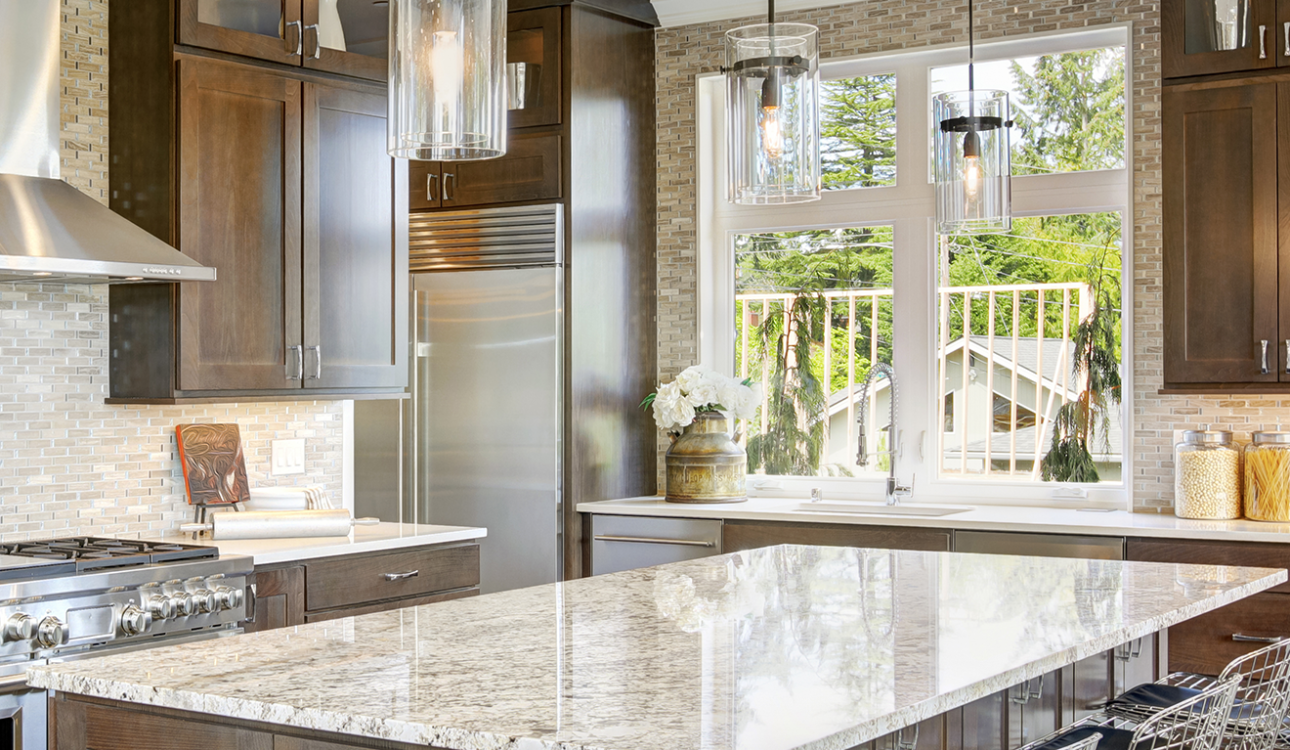
Broad, low-contrast movement looks better from across the room than tiny detail or sharply repeated veining. From several feet away, the eye reads direction and color balance before individual crystals or narrow lines.
We explain this to homeowners comparing countertop installers in Kingston Springs, TN because a slab can look impressive at arm’s length yet disappear once it is installed across a large island. At ARCountertops, we evaluate stone from close range, standing distance, and the main entrance to the kitchen before approving a layout.
Why Does Viewing Distance Change a Stone Pattern?
Viewing distance changes a pattern because the eye combines small details into larger shapes.
Up close, we may notice quartz crystals, mica, fine veins, and slight color changes. From ten or fifteen feet away, those details blend together and the surface is read as one broad field.
This is why fine-speckled granite may look active in a sample but calm after installation. One wide quartzite vein may also create more impact than dozens of thin printed lines.
| Pattern type | Appearance up close | Appearance across the room |
|---|---|---|
| Fine speckling | Detailed and mineral-rich | Soft and nearly uniform |
| Broad clouding | Subtle tonal variation | Calm depth |
| One wide vein | Strong local feature | Clear focal movement |
| Dense thin veins | Intricate | May become visual noise |
| Large color blocks | Dramatic variation | Strong architectural contrast |

Which Patterns Improve Most With Distance?
Broad, continuous, moderately contrasted patterns improve most with distance.
We see this in quartzite with sweeping bands, granite with large mineral fields, marble with a few dominant veins, and quartz with soft cloud-like movement. These patterns remain readable from a dining area or adjoining living room.
When planning with countertop installers in Kingston Springs, TN, we compare the slab with the longest available sightline, not only with the view from the sink.
Why Are Small Samples Misleading?
Small samples are misleading because they remove scale, repetition, and overall color distribution from the decision.
A six-inch sample may show one attractive vein but reveal nothing about repetition or large color shifts.
We prefer full-slab viewing whenever possible. The slab shows us focal areas, quieter sections, color shifts, and any feature that could be lost inside a sink or cooktop cutout.
At ARCountertops, we also review the slab horizontally because material displayed vertically may feel different once it becomes a countertop.
Should the Island Have a Different Pattern From the Perimeter?
Sometimes, because an island is usually viewed from farther away and from more directions than the perimeter.
Perimeter counters are interrupted by cabinets and appliances, while an island is open and visible from adjoining rooms. Broad movement can therefore give an island more architectural presence.
| Surface | Typical view | Useful pattern strategy |
|---|---|---|
| Perimeter | Close and partly shaded | Fine or medium movement |
| Large island | Seen from several rooms | Broad directional movement |
| Peninsula | Viewed along one axis | Movement following its length |
| Range wall | Eye-level focal point | One controlled feature |
| Beverage station | Close and narrow | Smaller-scale pattern |
How Does Vein Direction Affect the Long View?
Vein direction controls whether the countertop visually lengthens, widens, or fragments the room.
Movement running along a long island can make it appear longer. Crosswise veining may make a narrow island feel wider, but it can also create stronger breaks when multiple pieces are needed.
Around corners, the movement should turn naturally or transition through a calmer section. A dominant vein that stops abruptly at a seam can be more noticeable from across the room than from directly above.
At ARCountertops, we map vein direction before cutting so the pattern supports the room’s proportions.
Do Quiet Patterns Disappear From Far Away?
Some do, but that can be an advantage rather than a problem.
A fine aggregate or warm-gray quartz may read as one calm surface from across the room. That works well when cabinetry, flooring, or lighting already provides strong visual interest.
When Does Dramatic Stone Become Too Much?
Dramatic stone becomes too much when it competes with cabinet grain, backsplash design, flooring, and visible furnishings.
A bold slab may feel balanced in a showroom but become busier after lighting, furniture, and daily objects are added.
We usually recommend one dominant pattern, with quieter perimeter and backsplash surfaces.
| Existing feature | Better stone response |
|---|---|
| Strong-grain wood cabinets | Broad, low-contrast movement |
| Patterned floor | Quiet or softly clouded surface |
| Decorative range hood | Controlled movement nearby |
| Open shelving | Fewer competing veins |
| Minimal painted cabinets | More freedom for dramatic stone |
How Does Lighting Change a Pattern From Across the Room?
Lighting changes which areas remain visible and how strongly the slab reflects its surroundings.
Polished stone deepens color but may create glare. Honed surfaces make broad movement easier to read, while leathered granite adds depth without mirror-like shine.
Warm 2700K lighting strengthens cream, gold, and brown. Neutral 3000K lighting usually keeps warm and cool minerals balanced, while 4000K light emphasizes gray, white, and blue.
For homeowners selecting countertop installers in Kingston Springs, TN, we recommend evaluating the material under lighting similar to the finished kitchen.
Which Materials Hold Their Pattern Best at Distance?
Quartzite and directional granite usually hold strong movement best, while subtle quartz and fine granite become calmer.
| Material | Pattern at distance | Heat resistance | Maintenance |
|---|---|---|---|
| Granite | Mineral fields merge into broad movement | Excellent | Usually needs sealing |
| Quartz | Remains controlled and predictable | Moderate | No sealing |
| Marble | Major veins stay visible | Good | Sealing and etch awareness |
| Quartzite | Crystalline bands remain dramatic | Excellent | Usually needs sealing |
Granite ranges from nearly uniform to strongly directional. Quartz is predictable, marble is softer but more etch-sensitive, and quartzite offers dramatic movement at a higher typical cost.
How Should Seams Be Planned?
Seams should be placed in quieter areas, at cabinet breaks, or where the eye expects a transition.
A seam can be tight and level yet still look disruptive if a large vein stops at the joint. This is especially noticeable on an island viewed from the living room.
We review slab layout, seam color, vein direction, access, and support together before fabrication.
How Much Do Statement Countertops Cost?
Installed countertop materials generally cost about $45 to more than $200 per square foot.
Material rarity, slab size, finish, cutouts, seams, edges, and access all affect the total.
| Material | Typical installed range |
|---|---|
| Granite | $45–$120+ per sq. ft. |
| Quartz | $55–$140+ per sq. ft. |
| Marble | $70–$180+ per sq. ft. |
| Quartzite | $80–$200+ per sq. ft. |
Homeowners comparing countertop installers in Kingston Springs, TN should ask whether pattern layout, seam planning, cutouts, delivery, installation, and sealing are included in the written estimate.
At ARCountertops, we prepare project-specific pricing after reviewing the actual slab and cabinet plan.
What Is Included in Professional Fabrication?
Professional fabrication includes measuring, slab layout, cutting, edge work, cutouts, seam preparation, delivery, and installation.
A project may include:
- Material and finish consultation
- Digital templating
- Full-slab pattern review
- Sink and cooktop cutouts
- Faucet-hole drilling
- Edge fabrication
- Seam and corner planning
- Waterfall or backsplash fabrication
- Delivery and professional installation
- Sealing when natural stone requires it
- Final care instructions
How Long Does Fabrication and Installation Take?
Most projects take approximately 10–14 business days from final templating to installation.
| Project stage | Typical timing |
|---|---|
| Material selection | 1–5 days |
| Digital templating | One appointment |
| Slab layout review | 1–2 days if needed |
| Fabrication | 5–10 business days |
| Installation | Usually one day |
| Plumbing reconnection | Same day or next day |
Before measuring with countertop installers in Kingston Springs, TN, cabinets should be installed, level, secured, and in their permanent positions. Sink, faucet, range, and cooktop specifications should also be final.
What Selection Mistakes Should Homeowners Avoid?
The biggest mistakes are choosing at arm’s length, ignoring the main sightline, and approving material without understanding the full pattern.
We recommend avoiding:
- Selecting from a small sample alone
- Looking only at the slab vertically
- Ignoring the island view from adjoining rooms
- Placing the best feature inside a sink cutout
- Rotating pieces without reviewing vein direction
- Using strong stone beside several competing patterns
- Approving seams without a layout review
- Evaluating color under only one light source
FAQ
Which pattern looks best from far away?
Broad, continuous, moderately contrasted movement usually remains most legible from a distance.
Do fine granite patterns disappear?
They often blend into a calmer overall color, which can help in a visually active room.
Is dramatic quartzite good for an island?
Yes. A large island provides enough area for broad natural movement to develop.
Should veins run lengthwise on an island?
Often, because lengthwise movement emphasizes the island’s proportions. The room layout determines the final direction.
Does a honed finish help?
It can. Honing reduces glare and makes broad movement more consistent from different angles.
Can seams ruin the distant view?
A poorly placed seam can interrupt a dominant vein. Careful layout reduces that risk.
Should we view the full slab?
Yes, especially for natural stone and high-movement quartz.
How long does installation take?
Most projects take about 10–14 business days after final templating.
About ARCountertops
Our showroom is located at 1771 US-70, Kingston Springs, TN 37082. Call us at (615) 798-0912.
We serve Nashville, TN, Kingston Springs, TN, and surrounding communities with material selection, digital templating, full-slab layout planning, custom fabrication, sink and cooktop cutouts, edge finishing, backsplash fabrication, delivery, sealing, and professional installation. We work with granite, quartz, marble, and quartzite for kitchens, islands, bathrooms, vanities, waterfall panels, and other residential surfaces.
Our suppliers include Cambria, MSI, Cosmos Surfaces, Stoneland, Avani Marble and Granite, Daltile, OHM International, Cosentino Nashville, and Wilsonart.
For homeowners choosing countertop installers in Kingston Springs, TN, we help evaluate stone from close range and across the room, then plan pattern direction, focal areas, seams, finish, pricing, fabrication, and installation around the way the finished kitchen will actually be seen.